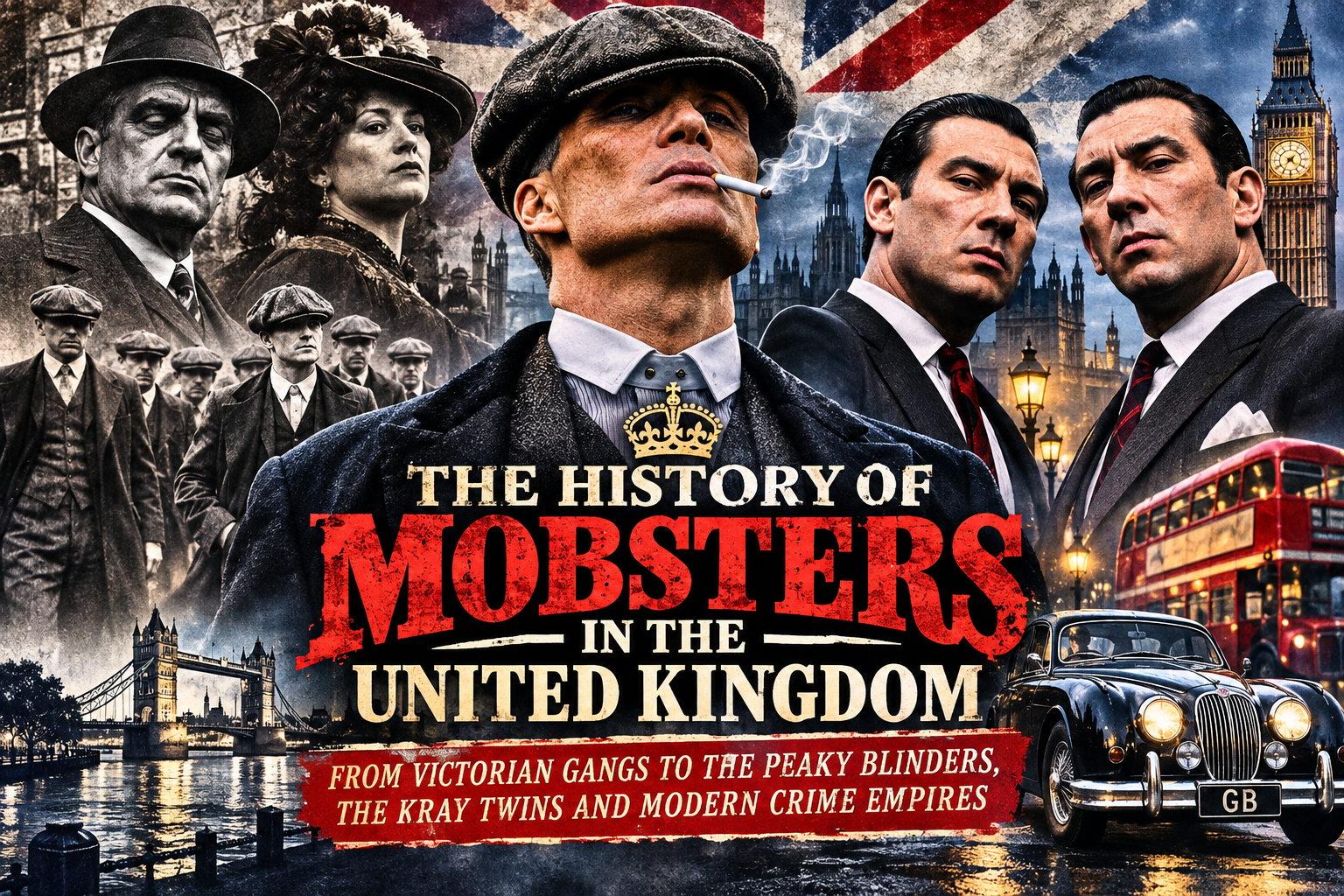
The History of Mobsters in the United Kingdom: From Victorian Street Gangs to Modern Crime Empires
The History of Mobsters in the United Kingdom: From Victorian Street Gangs to Modern Crime Empires
Explore the fascinating and often brutal history of British organised crime, from the backstreets of Victorian London and Birmingham to the notorious Kray twins, the Richardson gang, and today’s international criminal networks.
When most people hear the word mobster, they picture American gangsters such as Al Capone, Lucky Luciano, or John Gotti. They imagine sharp suits, expensive cars, smoky nightclubs, and ruthless criminal empires.
But the United Kingdom has its own extraordinary history of gangsters, crime bosses, and organised criminal networks.
Long before Hollywood popularised the American Mafia, British gangs were fighting for control of city streets, gambling operations, protection rackets, and lucrative illegal businesses.
From the notorious Peaky Blinders of Birmingham to the feared Kray twins of London’s East End, Britain’s underworld has produced characters every bit as colourful, dangerous, and controversial as their American counterparts.
1. The Early Days: Victorian Britain’s Criminal Underworld
Organised street crime in Britain dates back centuries, but the rapid urbanisation of the nineteenth century created conditions in which criminal gangs could flourish.
Industrial cities such as London, Birmingham, Liverpool, Manchester, and Glasgow experienced enormous population growth. Poverty, overcrowded housing, unemployment, and limited policing in certain neighbourhoods helped create opportunities for criminal activity.
In Victorian London, street gangs operated in impoverished districts, particularly around the East End and parts of South London.
These groups were involved in activities such as theft, robbery, illegal gambling, intimidation, and territorial violence.
One of the most notorious criminal organisations of the period was the Forty Elephants, an all-female gang of thieves associated with London’s Elephant and Castle district.
Active in various forms from the nineteenth century into the twentieth, the Forty Elephants specialised in shoplifting, stolen goods, and organised retail theft.
Their activities demonstrated that Britain’s criminal underworld was not exclusively male-dominated.
2. The Peaky Blinders: Birmingham’s Famous Street Gang
Perhaps no British gang has captured the modern imagination quite like the Peaky Blinders.
The real Peaky Blinders emerged in Birmingham during the late nineteenth century, particularly in the 1890s.
They were associated with working-class neighbourhoods, street violence, theft, and confrontations with rival gangs.
Members became known for their distinctive appearance, which reportedly included tailored jackets, scarves, and peaked caps.
A popular legend claims that gang members stitched razor blades into the peaks of their caps to use as weapons. However, historians generally regard this story as doubtful, particularly given the cost and availability of disposable razor blades during the gang’s early years.
The gang’s actual history differs considerably from the fictional portrayal in the television series Peaky Blinders.
The real gang was primarily active decades before the show’s post-First World War setting.
Nevertheless, the series introduced millions of viewers worldwide to Birmingham’s historical criminal underworld.
3. Billy Kimber and the Birmingham Boys
By the early twentieth century, Britain’s criminal gangs were becoming increasingly organised.
One of the most influential figures was Billy Kimber, a Birmingham-born gangster who became associated with the Birmingham Boys.
Kimber’s organisation exercised influence over racecourse gambling and bookmaking operations, particularly during the years surrounding the First World War.
At the time, horse racing attracted enormous crowds and substantial amounts of money.
Criminal gangs recognised that controlling bookmakers and racecourse territories could generate significant income.
Kimber and his associates competed with rival organisations, including gangs associated with London gangster Charles “Darby” Sabini.
Violence, intimidation, and confrontations between rival groups became features of Britain’s racecourse criminal economy.
These conflicts helped establish a pattern that would recur throughout British organised crime: control the territory, control the money.
4. The Sabini Gang: London’s Racecourse Kings
During the 1920s and 1930s, Charles “Darby” Sabini became one of London’s best-known underworld figures.
Born in London to an Italian father and English mother, Sabini developed connections within the capital’s gambling and criminal circles.
His organisation became particularly associated with racecourse protection rackets and disputes over bookmakers.
Sabini’s associates clashed with rival groups, including the Birmingham Boys and other London-based gangs.
Unlike the fictional Mafia-style organisations often depicted in films, these British gangs operated through shifting alliances, local connections, intimidation, and personal loyalties.
Sabini’s influence declined during the Second World War, but his career remains an important chapter in the development of organised crime in Britain.
5. The Kray Twins: London’s Most Famous Gangsters
No discussion of British mobsters would be complete without Ronnie and Reggie Kray.
Born in London’s East End in 1933, the identical twins became two of the most infamous figures in British criminal history.
During the 1950s and 1960s, the Krays established a criminal organisation commonly known as The Firm.
Their activities included protection rackets, extortion, violence, and involvement in the nightclub business.
The twins cultivated a glamorous public image, mixing with celebrities, entertainers, and prominent figures in London’s nightlife scene.
Their association with fashionable clubs helped create an image of sophisticated gangsters who combined criminal power with celebrity status.
But behind the expensive suits and publicity lay a violent criminal enterprise.
Ronnie Kray murdered George Cornell at the Blind Beggar pub in 1966. Reggie Kray murdered Jack “the Hat” McVitie in 1967.
In 1969, both twins received life sentences following their convictions for murder.
Their story has inspired numerous books, documentaries, and films, including Legend.
The Krays remain enduring symbols of London’s gangster era, although their celebrity has often overshadowed the suffering of their victims.
6. The Richardson Gang: South London’s Brutal Rivals
While the Kray twins dominated headlines in East London, another powerful criminal organisation operated south of the River Thames.
The Richardson gang, led by brothers Charlie and Eddie Richardson, became notorious during the 1960s.
Their criminal activities included fraud, extortion, and violent intimidation.
The gang developed a particularly fearsome reputation because of its use of torture against people it considered enemies or informants.
The Richardson organisation’s rivalry with other criminal groups contributed to the violent atmosphere of London’s underworld during the decade.
The gang was eventually dismantled through police investigations and criminal prosecutions.
The Richardson brothers’ story illustrates a darker reality behind the romantic image of Britain’s gangsters: organised crime frequently depended on extreme violence and fear.
7. Liverpool, Manchester, and Glasgow: Crime Beyond London
Although London produced many of Britain’s most famous gangsters, organised crime was never confined to the capital.
Liverpool developed criminal networks connected to its busy docks, where smuggling and stolen goods provided opportunities for illegal enterprise.
During the late twentieth century, the expansion of international drug trafficking transformed parts of Merseyside’s criminal underworld. Criminal organisations increasingly competed over drug distribution and the profits associated with it.
Manchester also experienced the growth of organised criminal groups, particularly during the 1980s and 1990s. Territorial disputes and drug-related violence became major concerns for police and local communities.
In Glasgow, criminal gangs had been part of the city’s history since the nineteenth century. During the twentieth century, territorial rivalries and organised racketeering became associated with parts of the city’s underworld.
One of Scotland’s most notorious gangland figures was Arthur Thompson, often described in the press as the Godfather of Glasgow.
His reputation reflected the influence that certain criminal personalities could exercise through intimidation, personal connections, and alleged involvement in organised rackets.
These regional histories show that Britain’s underworld developed differently from city to city, shaped by local economies, social conditions, and criminal opportunities.
8. The Rise of Drug Empires: The 1970s to the 1990s
By the 1970s and 1980s, British organised crime was changing dramatically.
Traditional protection rackets and gambling-related activities were increasingly joined by large-scale drug trafficking.
The growing markets for heroin, cocaine, cannabis, and other illegal substances offered criminal organisations opportunities to make far greater profits.
International connections became essential.
Rather than controlling only a few streets or nightclubs, successful criminal networks could now participate in operations stretching across Europe and beyond.
Money laundering also became increasingly important as criminals sought to disguise their illegal earnings through apparently legitimate businesses and financial transactions.
The old-fashioned gangster image of the sharply dressed nightclub owner began to give way to more secretive operators who relied on international contacts, intermediaries, and complex financial arrangements.
9. British Gangsters in Film and Television
British organised crime has had an enormous influence on popular entertainment.
Films and television programmes have transformed historical gangsters and fictional crime bosses into internationally recognised characters.
Among the most influential productions are:
-
The Long Good Friday (1980) — A London crime boss attempts to expand his empire while facing a violent threat.
-
Get Carter (1971) — A grim portrayal of the criminal underworld in Newcastle.
-
Lock, Stock and Two Smoking Barrels (1998) — A darkly comic story of London criminals and gangland rivalries.
-
Snatch (2000) — A fast-paced crime comedy involving gangsters, boxing, and stolen diamonds.
-
Peaky Blinders (2013–2022) — A fictionalised portrayal of Birmingham’s criminal underworld.
-
Legend (2015) — A dramatisation of the rise and downfall of Ronnie and Reggie Kray.
These productions helped establish the British gangster as a recognisable figure in international popular culture.
However, the cinematic version often differs significantly from historical reality.
Real gangsters were rarely as charming, loyal, or glamorous as their fictional counterparts.
10. Modern British Organised Crime: A New Generation
In the twenty-first century, organised crime in the United Kingdom has become increasingly international, technologically sophisticated, and financially complex.
Traditional criminal gangs still exist, but many modern organisations operate through loosely connected networks rather than a single identifiable crime boss.
According to the UK’s National Crime Agency, major threats include international drug trafficking, money laundering, cybercrime, fraud, firearms trafficking, and human exploitation.
A particularly troubling development has been the growth of county lines drug networks, in which criminal groups distribute drugs across regional boundaries, often exploiting children and vulnerable adults.
The National Crime Agency’s 2026 assessment also highlights the significance of international money laundering networks, organised cocaine trafficking, and technology-enabled crime.
National Crime Agency+1
Modern criminal organisations may have little resemblance to the traditional mobsters of the 1960s.
Instead of operating from nightclubs and gambling dens, some criminals coordinate their activities through encrypted communications, digital financial systems, and international networks.
The methods have changed, but the underlying motivations remain familiar: money, influence, and control.
11. The Myth and Reality of the British Gangster
There is something undeniably fascinating about the history of British mobsters.
The expensive suits, luxury cars, famous nightclubs, and dramatic rivalries have helped create an enduring mythology.
The Krays became celebrities. The Peaky Blinders became television icons. Criminal figures who once terrorised neighbourhoods have been transformed into subjects of documentaries, films, books, and merchandise.
Yet the reality was frequently far less glamorous.
Behind the mythology were victims of extortion, violent assaults, murders, intimidation, and exploitation.
The London Museum’s account of the Kray twins, for example, documents both their celebrity connections and the murders that ultimately led to their imprisonment.
London Museum
Understanding the history of British gangsters requires recognising both sides of the story: the cultural fascination and the human consequences.
Conclusion: From Flat Caps to International Crime Networks
The history of organised crime in the United Kingdom is a story of constant evolution.
From Victorian street gangs to the Peaky Blinders, from the racecourse racketeers of the 1920s to the Kray twins of the swinging sixties, British mobsters have repeatedly adapted to changing economic and social conditions.
Today’s criminal networks operate on a far larger and more international scale than many of their predecessors could have imagined.
Yet the fundamental elements of organised crime—profit, intimidation, rivalry, and the pursuit of power—have remained remarkably consistent.
The era of the traditional British gangster may belong largely to history, but organised crime itself has never disappeared.
It has simply changed its appearance.
And while the fictional mobsters of television and cinema continue to entertain audiences, the true history of Britain’s underworld remains a compelling, complicated, and often disturbing subject.
SEO details for WordPress
SEO Title: History of British Mobsters: Peaky Blinders, Kray Twins & UK Gangsters
Meta Description: Discover the history of British organised crime, from Victorian street gangs and the Peaky Blinders to the Kray twins and modern UK crime networks.
Suggested URL Slug: history-of-british-mobsters-and-gangsters
Categories: British Crime History, Gangsters, Organised Crime, UK History
Tags: British Mobsters, UK Gangsters, Kray Twins, Peaky Blinders, Ronnie Kray, Reggie Kray, Richardson Gang, Billy Kimber, Sabini Gang, London Gangsters, Birmingham Gangs, British Organised Crime, Gangster History, Mobland UK
Historical references
The article draws on historical and official sources, including Birmingham City Council, London Museum, Smithsonian Magazine, and the National Crime Agency’s 2026 assessment.
